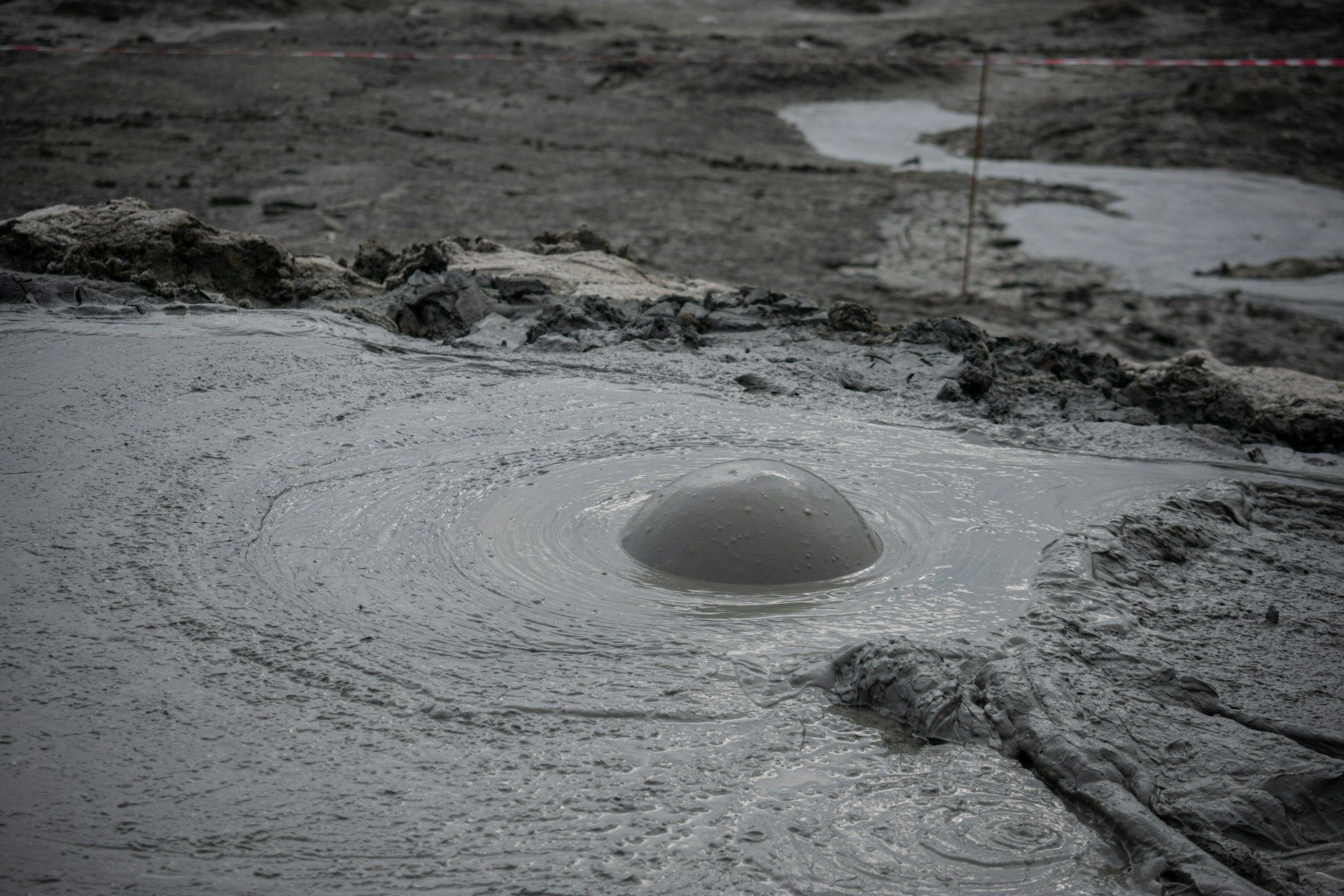
Mud Volcanoes: A Spa Day in the Earth's Crust
Forget lava. In Azerbaijan, volcanoes erupt with cold, grey mud.
Azerbaijan is home to nearly half of the world's mud volcanoes—over 400 of them. These bizarre geological formations bubble, burp, and occasionally explode, creating a landscape that looks like the surface of another planet.
And the best part? You can touch the mud, even bathe in it. Some say it has therapeutic properties. Others just think it's fun.
Welcome to one of nature's strangest spa treatments.
What is a Mud Volcano?
A mud volcano is a geological formation where gas (usually methane) and underground water mix with clay and minerals, creating a thick mud that erupts to the surface.
How They Work:
- Gas Pressure Builds: Deep underground, natural gas accumulates.
- Mud Forms: The gas mixes with water and sediment.
- Eruption: Pressure forces the mud to the surface through cracks in the earth.
The Result:
- Small Bubbles: Gentle gloop-gloop sounds.
- Mud Flows: Slow-moving rivers of grey mud.
- Explosions: Rare but dramatic. Some mud volcanoes erupt violently, shooting mud and flames (yes, flames) into the air.
Why Does Azerbaijan Have So Many?
Azerbaijan sits on a unique geological zone where:
- Tectonic Activity: The collision of tectonic plates creates pressure.
- Oil and Gas Reserves: Massive underground reserves of natural gas.
- Sedimentary Layers: Thick layers of clay and sediment.
The Result: Perfect conditions for mud volcanoes.
The Landscape: Mars on Earth
Visiting a mud volcano field is surreal. The landscape is:
- Barren: No vegetation, just cracked earth and grey mud.
- Silent: Except for the bubbling of the mud.
- Otherworldly: It genuinely looks like another planet.
Fun Fact: NASA has studied Azerbaijan's mud volcanoes as analogs for potential geological features on Mars and Titan (Saturn's moon).
Are They Safe?
Yes, Mostly.
- The Mud is Cold: Unlike lava volcanoes, mud volcanoes are not hot. The mud is room temperature or slightly warm.
- The Gas is Flammable: Methane gas can ignite, but this is rare and usually happens only during major eruptions.
Safety Tips:
- Don't Stand Directly Over Active Vents: The ground can be unstable.
- No Open Flames: The area is rich in methane gas.
- Watch Your Step: The mud can be slippery.
The Famous Mud Volcanoes
1. Gobustan Mud Volcanoes
- Location: 60 km south of Baku, near Gobustan National Park.
- Highlights: Multiple active volcanoes, easy to access.
- Best For: First-time visitors.
How to Get There:
- By tour (combined with Gobustan petroglyphs).
- By car (4x4 recommended for the last stretch).
2. Dashgil Mud Volcano
- Location: Near Gobustan.
- Highlights: Large, active, and photogenic.
- Famous For: Erupted in 2001, shooting flames 15 meters high.
3. Lokbatan Mud Volcano
- Location: Near Baku (accessible from the city).
- Highlights: Close to the city, easy access.
- Note: Smaller and less dramatic than Gobustan.
4. Ayranteken Mud Volcano
- Location: Absheron Peninsula.
- Highlights: Remote, pristine.
- Best For: Adventurous travelers.
The Therapeutic Properties: Fact or Fiction?
Locals believe mud volcano mud has healing properties.
Claimed Benefits:
- Skin Health: Rich in minerals (iodine, bromine, boron).
- Anti-Inflammatory: Used to treat joint pain and arthritis.
- Detoxifying: Draws out impurities from the skin.
The Science:
- Some studies support the mineral content claims.
- The mud is similar to therapeutic mud used in spas worldwide.
- But: It's not regulated or tested for safety. Use at your own risk.
How to Use:
- Scoop up some mud.
- Apply to your skin.
- Let it dry (10-15 minutes).
- Rinse off (bring water).
Warning: Don't ingest the mud. It's not edible.
Visiting the Mud Volcanoes: Practical Guide
Best Time to Visit:
- Spring (April-May): Mild weather, fewer tourists.
- Autumn (September-October): Comfortable temperatures.
- Avoid: Summer (too hot, over 40°C) and winter (muddy roads after rain).
What to Bring:
- Old Clothes: You will get muddy.
- Water: For drinking and rinsing.
- Sunscreen and Hat: No shade.
- Camera: The landscape is incredibly photogenic.
- Wet Wipes: For cleaning hands.
What to Wear:
- Closed Shoes: The ground is uneven and muddy.
- Light, Breathable Clothes: It can be hot.
How to Get There
Option 1: Organized Tour
- Pros: Easy, includes transport and guide.
- Cons: Less flexible.
- Price: 40-80 AZN per person (often combined with Gobustan petroglyphs).
Option 2: Rent a Car
- Pros: Flexible, can explore multiple sites.
- Cons: Roads can be rough (4x4 recommended).
- Price: 50-100 AZN per day for car rental.
Option 3: Taxi
- Pros: Cheaper than a tour, more flexible than public transport.
- Cons: Need to negotiate price.
- Price: 60-100 AZN round trip from Baku.
Combine with Gobustan
Most visitors combine the mud volcanoes with Gobustan National Park (ancient petroglyphs).
Suggested Itinerary:
- Morning: Gobustan petroglyphs and museum (2-3 hours).
- Afternoon: Mud volcanoes (1-2 hours).
- Return to Baku: Late afternoon.
Fun Facts About Mud Volcanoes
1. They Can Explode
In 2001, the Lokbatan Mud Volcano erupted with flames visible from Baku. No one was hurt, but it was spectacular.
2. They're Ancient
Some of Azerbaijan's mud volcanoes have been active for thousands of years.
3. They're on Islands
Some mud volcanoes are located on small islands in the Caspian Sea (accessible only by boat).
4. They're Studied by Scientists
Geologists from around the world come to Azerbaijan to study these formations.
Photography Tips
Best Shots:
- Wide Angle: Capture the barren landscape.
- Close-Up: Bubbling mud in action.
- Sunset: Golden light on the grey mud creates stunning contrast.
Drone Photography:
- Allowed, but check local regulations.
- Aerial shots of the mud fields are incredible.
Conclusion
Mud volcanoes are one of Azerbaijan's most unique natural wonders. They're bizarre, beautiful, and a little bit otherworldly.
So grab some old clothes, embrace the mud, and experience a spa day like no other—courtesy of the Earth's crust.
Next up in our series: Skiing in the Caucasus: Shahdag vs. Tufandag